Written by : Knowledge Centre Team
Last published : 2025-12-22
5 minutes read
Share

SIP (Systematic Investment Plan) is a plan to invest in your preferred mutual fund scheme regularly. Each month, a fixed amount is deducted from your savings amount and invested in your choice of a mutual fund.
A systematic investment plan, is a recurrent investment plan, or a periodic investment plan, with an automatic savings method that allows people to set aside a fixed amount of money regularly (or a fixed number of shares if using stock bonds). Investment such as stocks, mutual funds, or ETFs offers you to choose a particular deposit or investment frequency such as quarterly or monthly.
For example, you can set up a SIP so that every month, on a specific date, a chosen amount is invested in a mutual fund of your choice. Dates for SIPs are usually the 1st, 15th, or 30th of the month, but sometimes it can be any day or date you specify, depending on the mutual fund company or broker's rules for SIPs. You can invest as little as 500 rupees a month in this plan.
Also Read - What is SIP?
Investors can choose from a number of investing options, including systematic investment programmes, through mutual funds and other investment companies. SIPs allow investors to invest minimal amounts of money over time instead of making large investments all at once.
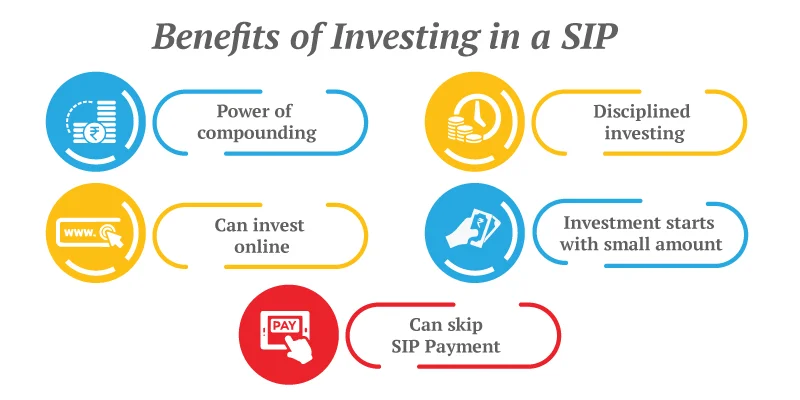
Most SIPs demand continuous payments on the plans, whether weekly, monthly, or quarterly. SIPs enable investors to invest small amounts of money while still benefiting from the lower average dollar cost.
The principle of systematic investing is simple. Systematic Investment Plan works with the regular and periodic purchase of shares or units of securities of a fund or other investment. As a result, shares are bought at different prices and in varying amounts, although some plans may allow you to designate a fixed number of shares to buy. Because the amount invested is generally fixed and does not depend on unit prices or shares, an investor ends up buying fewer shares when unit prices rise and more shares when prices fall.
SIPs tend to be passive investments because you continue to invest in them once you put money in, regardless of their performance. That is why it is essential to keep an eye on how much wealth you accumulate in your SIP.
Once you have reached a certain amount or are nearing retirement, you may want to reconsider your investment plans. Moving to an actively managed strategy or investment can allow you to grow your money even more. But it is always a good idea to speak with a financial advisor or an expert to determine the best situation.
SIPs offer investors a variety of advantages. The foremost and most obvious advantage is that once you fix the amount you want to invest and the frequency, there is not much else to do. Since many SIPs are automatically funded, you have to make sure the funding account has enough money to cover your contributions. It also allows you to use a small amount to don't feel the effects of a large lump sum withdrawn in one go.
If you are using SIP, it reduces the risk and uncertainty that you are likely to experience with other investments like stocks and bonds. And thus, it requires a certain amount at regular intervals, as you are also establishing some discipline in your financial life.
Automating your investment and saving plans effectively to overcome your worst enemy as an investor – YOU! The personal finance subcategory, Behavioral Finance, demonstrates that human behavior (such as the potentially self-destructive emotions of greed, fear, and complacency) can have more impact on the performance of an investment portfolio than asset allocation or investment selection.
Investors frequently make their worst selections when they are experiencing strong emotions. For instance, when stock prices are high, and headlines herald new highs in stock indexes and a seemingly endless profit environment, investors tend to buy riskier assets like stocks and stock mutual funds. The opposite is also true. When stock prices drop drastically over a long period of time, many investors tend to sell their shares. This habit of "buy high and sell low" is in direct contrast to smart investing.
A systematic investment plan removes the thrill of investing by buying investment stocks periodically, regardless of what's happening in the financial markets or what the media is saying.
The above calculation and illustration of figures are indicative only and not on actual basis.
An OTP has been sent to your mobile number

Sorry ! No records Found
Thank You for submitting the response, will get back with you.
Thank you for your interest in our product. Our financial expert will connect with you shortly to help you choose the best plan.







We bring you a collection of popular Canara HSBC life insurance plans. Forget the dusty brochures and endless offline visits! Dive into the features of our top-selling online insurance plans and buy the one that meets your goals and requirements. You and your wallet will be thankful in the future as we brighten up your financial future with these plans.