Exchange Traded Fund | Financial Planning | Saving and Investment Plan

All You Need to Know about ETF Investment

Understand ETFs, how they work, and their benefits to decide if they're the right investment choice for building long-term wealth efficiently.

Written by : Knowledge Centre Team

2026-01-10

4899 Views

6 minutes read

Ever since their launch in 1993 in the USA, ETFs or Exchange Traded Funds have gained popularity worldwide. In India, ETFs were introduced in 2002 by Benchmark Mutual Fund. The first ETF launched was the Nifty Benchmark Exchange-Traded Scheme (Nifty BeES). Today, investors consider a variety of options such as saving plans, mutual funds and gold bonds. ETFs are another investment avenue gaining attention. But how do ETFs work, and are they a worthwhile option for long-term investors?

Key Takeaways

  • ETFs are market-linked investment funds that trade on stock exchanges like shares.

  • They offer lower expense ratios compared to actively managed mutual funds.

  • ETF prices fluctuate during market hours based on supply and demand.

  • Investors can benefit from transparency, flexibility, and diversification with ETFs.

  • ETFs are ideal for both new and experienced investors seeking long-term growth.

What is an ETF?

Exchange-Traded Funds (ETFs) are investment funds that trade on stock exchanges, much like individual stocks. While many investors today are familiar with mutual funds and equities, ETFs remain misunderstood due to various myths and misconceptions, even among experienced investors.
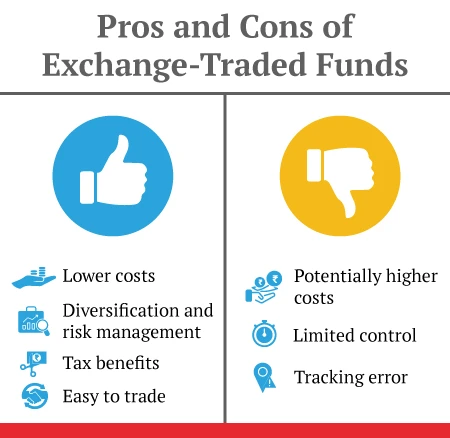
Like mutual funds, ETFs pool money from multiple investors to invest in a portfolio of assets. However, they differ in two key ways:

  • An Exchange Traded Fund (ETF) can be easily traded in a stock market, similar to shares.

  • ETFs are passively regulated funds and normally follow an index. It has emerged as one of the most widespread sorts of passive investing in the country.

ETFs (Exchange Traded Funds) are listed and traded on a stock exchange similar to other stocks. While each ETF has a Net Asset Value (NAV), its market price is determined by real-time supply and demand, which means it may trade slightly above or below its NAV. To invest in ETFs, one needs an active trading and a Demat account.

Learn how to invest in a mutual fund to get a monthly income.

Build Guaranteed Savings for Your Future Goals

Please enter correct name Please enter the Full name
Please enter valid mobile number Please enter Mobile Number
Please enter valid email Please enter Email

Enter OTP

An OTP has been sent to your mobile number

Didn’t receive OTP?

Application Status

Name

Date of Birth

Plan Name

Status

Unclaimed Amount of the Policyholder as on

Name of the policy holder

Policy No.

Address of the Policyholder as per records

Unclaimed Amount

Error

Sorry ! No records Found

.  Please use this ID for all future communications regarding this concern.

Request Registered

Thank You for submitting the response, will get back with you.

Thank you for your interest in our product. Our financial expert will connect with you shortly to help you choose the best plan.

Benefits of Investing in ETFs

With the help of these Exchange Traded Funds (ETFs), investors can easily control and leverage the growth potential of indices like the Sensex and Nifty. These ETFs hold the potential to take their revenue maximisation to a whole new level.

They simulate the performance of underlying assets like gold, index, or bonds where investors can gain index-linked profits at a more subordinate cost. They aim to deliver returns that closely track the performance of the chosen benchmark index.

However, since ETFs are market-linked instruments, returns are not guaranteed and may slightly deviate from the index due to tracking error.

Mentioned below are some of the advantages of investing in ETFs:

  1. ETFs are cCost-eEffective: ETFs are an investment product that have a lower expense ratio compared to mutual funds, as ETFs are regarded as passive funds. With minimal fund management costs and no active advisory fees, they offer a cost-efficient investment option.

    Additionally, operational costs are lower as brokers facilitate transactions, reducing the need for dedicated customer service teams and administrative overhead.

    This cost advantage makes ETFs one of the most economical choices for investors. When people invest through smaller sums, the benefits of compounding, combined with low costs, can help improve overall portfolio returns over the long term.

  2. ETFs have cComplete tTransparency: After investing in Exchange Traded funds, you can monitor the fund'sfund NAV (Net Asset Value) at any moment throughout market hours. When examining an ETF investment, you can identify the NAV (Net Asset Value) on the trading day.

    This level of transparency is higher than that of traditional open-ended mutual funds, which disclose their NAV only at the end of each trading day.

  3. ETF iInvestments are cConvenient: When compared to other market instruments, investing in ETFs is more convenient. They offer high liquidity, allowing investors to buy and sell units easily during market hours, just like stocks. Apart from this, you can further perform intraday deals through ETFs.

    Since ETFs are traded on stock exchanges, there are no redemption requests; investors simply sell their units to other buyers. This mechanism helps maintain stable Asset Under Management (AUM) and results in lower tracking errors compared to index mutual funds.

  4. ETFs pProvide tTrading fFlexibility: Along with providing users with the choice of purchasing and selling funds at any point in time during market hours, ETFs can be exchanged intraday. This intraday trading means investors can buy or sell units at market prices any time during trading hours.

    Their prices fluctuate throughout the day, just like stocks, based on the real-time value of their underlying assets.

    If you're looking to diversify your portfolio or gain exposure to specific markets, sectors, or themes, ETFs can be a suitable choice. They can also help manage market volatility more effectively than individual stocks, though like all market-linked investments, they still carry some level of risk.

    Understand the difference between portfolio management and financial planning.

Why ETFs Can Be a Strategic Long-Term Investment

ETF investors can quickly determine how much they’ve spent on purchasing units and the returns they've earned upon selling them. With their transparency, flexibility, and diversification benefits, ETFs offer a practical route to long-term wealth creation.

With the flexibility to buy or sell ETF units on stock exchanges at any time during market hours, these funds are not only ideal for first-time investors beginning their financial journey but also serve as an effective long-term strategy for seasoned investors.

Saving Plans as an Alternative to Exchange Traded Funds

While ETFs offer market-linked returns, they also come with a certain degree of risk. If you're looking for more stable investment options, saving plans can be a reliable alternative. If your goal is to build a retirement corpus or fund your child’s higher education, these plans provide security, tax benefits, and long-term growth. Canara HSBC Life Insurance offers a range of savings plans tailored to help you meet your financial milestones with confidence:

  1. Promise4Future: Promise4Future is a flexible savings plan designed to help you meet future milestones like education, marriage, or retirement. It offers guaranteed benefits along with customisable policy terms, premium payment options, and protection for your family, making it ideal for long-term planning.
    Learn more about Promise4Future

  2. iSelect Guaranteed Future: This plan provides guaranteed maturity benefits along with life cover, ensuring financial certainty for your loved ones. You can customise the plan as per your financial needs and choose from options like income, lump sum, or a mix of both at maturity.
    Learn more about iSelect Guaranteed Future

  3. SecureInvest: SecureInvest is a ULIP that allows you to grow your wealth while protecting your future through life insurance coverage. It offers portfolio strategies, fund switching options, and tax benefits,  ideal for investors seeking flexibility and growth potential.
    Learn more about SecureInvest

Conclusion

Choose a savings plan that aligns with your financial goals and risk appetite. While ETFs can offer diversification and market-linked growth, they also carry certain risks due to market volatility. For those seeking stability along with long-term wealth creation, savings plans can be a more structured alternative. Before investing, create a well-thought-out financial plan to assess your needs, affordability, and future goals. Consider inflation and life-stage milestones when selecting your plan.

Explore Canara HSBC Life’s wide range of savings and investment plans to find one that fits your financial objectives.


Recent Blogs

ESIC Scheme

What is ESIC? Employees' State Insurance Corporation Explained

08 July '26
3914 Views
15 minute read
Want to know about ESIC? Learn what Employees' State Insurance Corporation is, its benefits, eligibility & coverage for salaried employees in India.
Read More
Saving Plan
Sum Assured Meaning Thum Desktop

What is Sum Assured in Insurance? Meaning and Definition

19 Apr '26
4225 Views
8 minute read
A sum assured is a fixed amount paid to the nominee of the insurance policy in the unfortunate event of the policyholder's demise during the policy tenure. Learn more about what is sum assured, and it's meaning.
Read More
Saving Plan
What Are The Best Long Term Saving And Investment Plans Thum Desktop

Best Long-Term Saving and Investment Plans Explained

15 Apr '26
1285 Views
8 minute read
Learn about the best long-term saving and investment plans, how they help build wealth over time, and which options suit different financial goals and life stages.
Read More
Saving Plan
Senior Citizen Savings Scheme Thum Desktop

Senior Citizen Savings Scheme (SCSS): A Complete Guide

10 Apr '26
5626 Views
10 minute read
Learn what the Senior Citizen Savings Scheme (SCSS) is, how it works, interest rates, eligibility rules and why it is a popular low-risk option for retirees.
Read More
Saving Plan
Compound Interest Beat Inflation Thum Desktop

Top 5 Investment Options for NRIs in India

16 Mar '26
3494 Views
9 minute read
Explore the top investment options for NRIs in India, including tax efficiency, repatriation rules and how to choose plans aligned with long-term goals.
Read More
Saving Plan
Guaranteed Return Plan Thum Desktop

Top Investments with Guaranteed Returns in India in 2026

13 Mar '26
1980 Views
8 minute read
Discover top investment options in India with guaranteed returns. Secure your financial future with reliable plans from Canara HSBC Life Insurance. Explore now!
Read More
Saving Plan
When Should One Start Saving And What Is The Best Savings Plan Thum Desktop

When Should You Start Saving? Choose the Best Savings Plans

11 Mar '26
1090 Views
7 minute read
Learn the right age to start saving and how to choose the best savings plan to achieve your financial goals effectively.
Read More
Saving Plan
Compound Interest Beat Inflation Thum Desktop

Pradhan Mantri Jan Dhan Yojana: Eligibility & Benefits Explained

04 Mar '26
3856 Views
9 minute read
Pradhan Mantri Jan Dhan Yojana ensures financial inclusion by providing access to banking, insurance, pension, and credit for Indian citizens. Learn more!
Read More
Saving Plan
Best Saving Plans

12 Best Saving Plans & Schemes in India with High Returns

04 Mar '26
896 Views
7 minute read
Know about the best saving plans in India such as NSC, SCSS, RD, MIS, PPF, KVP, SSY, Atal Pension Yojana and more. Read this blog and choose the best savings scheme for yourself.
Read More
Saving Plan

Savings and Investment Plans from Canara HSBC Life Insurance

We bring you a collection of popular Canara HSBC life insurance plans. Forget the dusty brochures and endless offline visits! Dive into the features of our top-selling online insurance plans and buy the one that meets your goals and requirements. You and your wallet will be thankful in the future as we brighten up your financial future with these plans.


Fixed Returns, Zero Risks & Worries

iSelect Guaranteed Future Plus
  • 4 Plan Options
  • Life cover + Guaranteed benefits
  • Accidental death benefit
  • Premium protection cover

Save, Dream, Plan. Live Peacefully

iSelect Guaranteed Future Plan
  • 4 plan options
  • Guaranteed Maturity Benefit
  • Premium Protection Cover
  • Tax Benefits