



everything-you-should-know-about-national-saving-certificate

Everything You Should Know about National Saving Certificate

Learn everything about National Savings Certificate (NSC): Interest rate, tax benefits, eligibility, withdrawal rules, and how to invest online

Written by : Knowledge Centre Team

Last published : 2026-01-10

8 minutes read

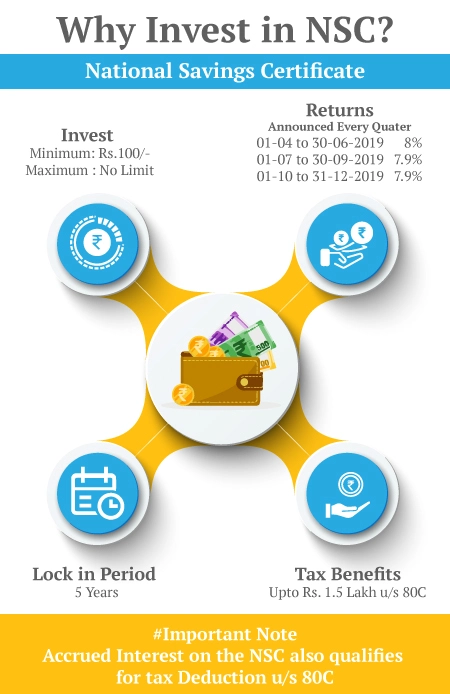
Saving money helps you build a strong financial base, but to grow your money, you also need to invest it wisely. Today, it’s easy to invest through options such as savings and life insurance plans. One simple, safe, and government-backed choice is the National Savings Certificate (NSC), a fixed-income savings scheme offered through India Post. It’s backed by the government and offers assured returns at around 7.7% per annum, along with tax benefits under Section 80C of the Income Tax Act. 

Let’s understand what the NSC scheme is and how it can help you save and grow your money.

Key Takeaways


  • NSC offers a safe and government-backed way to grow your savings with fixed returns
  • NSC offers tax deductions up to ₹1.5 lakh annually under Section 80C
  • NSC is ideal for conservative investors with a 5-year lock-in period for disciplined savings 
  • Flexible holding options make NSC suitable for both individual and joint investors
  • Premature withdrawal is allowed only in specific cases, ensuring long-term financial commitment

What is a National Savings Certificate?

The National Savings Certificate (NSC) is a popular fixed-income security aimed at promoting savings and investment among the country's people. The Government of India fosters these savings schemes through its Post Offices. It is a secure, low-risk product suitable for conservative investors, offering assured returns and tax benefits under Section 80C of the Income Tax Act. The interest rate for NSC is fixed at 7.7% per annum (compounded yearly and payable at maturity) for FY 2025-26, and this rate has remained unchanged for the January-March 2026 quarter.

Earlier, NSC had two variants, NSC Issue VIII and NSC Issue IX, based on maturity periods. However, currently, only one issue is open for subscription.

Build Guaranteed Savings for Your Future Goals

Please enter correct name Please enter the Full name
Please enter valid mobile number Please enter Mobile Number
Please enter valid email Please enter Email

Enter OTP

An OTP has been sent to your mobile number

Didn’t receive OTP?

Application Status

Name

Date of Birth

Plan Name

Status

Unclaimed Amount of the Policyholder as on

Name of the policy holder

Policy No.

Address of the Policyholder as per records

Unclaimed Amount

Error

Sorry ! No records Found

.  Please use this ID for all future communications regarding this concern.

Request Registered

Thank You for submitting the response, will get back with you.

Thank you for your interest in our product. Our financial expert will connect with you shortly to help you choose the best plan.

  • NSC Issue - VIII: This is the current and ongoing scheme with a maturity period of 5 years. Investors can start with a minimum investment of ₹1,000 and make subsequent investments in multiples of ₹100, with no maximum limit. The interest rate on this certificate is compounded annually and payable on maturity.
  • NSC Issue - IX: This issue with a 10-year maturity period is no longer available for new investments. It has been discontinued, and only the 5-year NSC Issue VIII is open for new subscriptions.

What are the 3 Types of Holdings in NSC?

You can hold an NSC in different ways. It can be just in your name or shared with someone else. Here are the three types:

  • Single Holder Type Certificate: Only one person can hold this type of certificate. Only individuals may issue such type certificates in their own name or on behalf of a minor (a minor must be at least 10 years old to hold an NSC in their own name); joint holders are prohibited.
    Nominees can be appointed, but all decisions (such as encashment, nomination changes, etc.) are made by the individual to whom the certificate is issued. When the individual passes away, the amount is given to the legal heirs or nominees, as applicable.

    Know all about the nominee in a life insurance plan.
  • Joint 'A' Type Certificate: This certificate is issued to two or more adults and is payable to all thejoint certificate holders or to the survivor(s) upon maturity.

    In the event of any legal changes, such as the transfer or cancellation of the certificate, or a change of nominee, the signatures of all holders are required.
  • Joint 'B' Type Certificate: In this kind of certificate, to two or more adults, but the maturity amount is payable to any one of the joint holders instead of all jointly. Apart from this, all the other features remain the similar to Joint ‘A’ Type certificate, including nomination and operational rules.
Do you know

Did You Know?

NSC certificates can also be used as collateral for loans with banks, once issued


Source: Business Today

Promise4 Wealth Plan - Canara HSBC Life Insurance

How Does a National Savings Certificate Work?

National Savings Certificate (NSC) is a simple one-time investment option that enables individuals to invest a lump-sum amount and earn a fixed interest rate over a defined period.

  • Easy to Start and Accessible: To invest in NSC, simply visit the nearest post office or use the online India Post portal (where available) and deposit the desired amount. There is no maximum investment limit, making it suitable for all types of investors.
  • Interest Calculation and Maturity: NSC comes with a maturity period of 5 years, depending on the chosen scheme. The current interest rate is 7.7% per annum, compounded annually, but paid out only at maturity. This annual compounding and reinvestment of interest helps your investment grow steadily over time.
  • Returns and Comparisons: Although the interest is received at the end of the term, it is compounded annually. NSC offers competitive interest rates among fixed-income, tax-saving instruments, especially for investors seeking guaranteed returns and Section 80C tax benefits.


Who is Eligible for NSC?

The National Savings Certificate (NSC) is designed to encourage resident individuals in India to save and invest securely.

Here’s who can and cannot invest in NSC:

  • Resident Individuals: Any Indian resident can invest in an NSC, making it an ideal option for salaried individuals, business owners, and retirees. It offers a safe, government-backed way to earn fixed interest while enjoying tax benefits. You can start with a small amount, and there’s no upper limit, making it a flexible option for long-term financial planning. Non-Resident Indians (NRIs), Hindu Undivided Families (HUFs), trusts, and institutions are not eligible to invest in NSC.
  • Minors: Parents or legal guardians can invest in NSC on behalf of a minor. The certificate will be in the child’s name, but the guardian will manage it until the child reaches maturity. A minor aged 10 years or above can also hold an NSC in their own name. Upon maturity, the proceeds are paid to the minor. This is a great way to build a secure fund for a child’s future education or other needs.
  • Joint Holders: Up to three adults can jointly invest in an NSC under either Joint Type A or Joint Type B. In Joint A, all the holders or the survivor(s) jointly receive the maturity amount. In Joint B, any one of the joint holders can receive it. For operational changes, the consent of all joint holders is required.. This option is suitable for couples or partners who plan to achieve a shared financial goal.

What are the NSC Withdrawal Rules?

Premature withdrawals before maturity are generally not allowed in NSC. However, the scheme allows for early encashment under specific conditions. Let’s understand each withdrawal scenario in detail below.

  • Lock-in Period Requirement: NSC investments come with a fixed lock-in period of five years, which means you cannot withdraw the invested amount before maturity under normal circumstances. This rule promotes financial discipline and long-term commitment. It is especially beneficial for conservative investors looking to grow their savings securely over time. Staying invested until maturity allows you to enjoy the full interest benefits and tax savings under Section 80C of the Income Tax Act.
  • Death of the Certificate Holder: If the person holding the NSC passes away, premature encashment is allowed. This applies to single holders or one of the joint holders. The legal nominee or joint holder may claim the investment before maturity. The death certificate and proof of identity are required during the claim process. 
  • Withdrawal on Court Order: NSC investments can be prematurely withdrawn if directed by a court of law. This typically occurs during legal proceedings, such as property disputes, financial settlements, or cases involving insolvency. The court’s order must mention the NSC details and withdrawal terms. Only upon submission of this official order can the post office permit early encashment of the certificate, even before its full five-year term has expired.
  • Forfeiture by a Gazetted Pledgee: If the NSC is pledged as security and the pledgee is a Gazetted Government Officer, the investor defaults on the obligation, the pledgee has the right to encash the certificate before maturity. This is permitted under post-office savings rules governing pledged certificates.
  • No Interest if Withdrawn Within 1 Year: If you withdraw your NSC within one year of purchase, you will not receive any interest. The post office will return only your principal amount. This rule helps ensure investors remain committed for longer periods.

Conclusion 

The National Savings Certificate is a trusted choice for disciplined, secure savings, especially for conservative investors seeking assured returns and tax benefits. However, if you're seeking additional benefits, such as life cover, guaranteed returns, and tax savings in one plan, we at Canara HSBC Life Insurance offers smart savings solutions tailored to your goals. Start planning today for a future that's protected and financially strong.

Glossary

  1. Nomination: A feature that allows the investor to appoint a person to receive the investment proceeds in case of death
  2. Section 80C: A provision of the Income Tax Act allowing deductions up to ₹1.5 lakh on eligible investments like NSC
  3. Lock-in Period: The minimum duration an investment must be held before withdrawal, fixed at 5 years for NSC
  4. Compounding: A process where earned interest is reinvested to generate additional returns over time
  5. Premature Encashment: Early withdrawal of an investment before maturity, allowed in NSC only under specific conditions
Glossary book
Uncertain About Insurance

FAQs

NSC full form stands for National Savings Certificate. It is a government-backed fixed-income savings scheme offered through India Post to encourage long-term savings with assured returns and tax benefits.


The NSC benefits make the National Savings Certificate a preferred choice for conservative investors. It is a government-backed, low-risk investment offering guaranteed returns at 7.7% per annum, compounded annually, with a 5-year lock-in. Among the key benefits of NSC are tax deductions up to ₹1.5 lakh under Section 80C, steady compounding growth, and the ability to use the certificate as collateral for loans. Additionally, the benefits of National Saving Certificate include easy accessibility through post offices, no maximum investment limit, and a nomination facility for the financial security of family members.

The National Savings Certificate interest rate is 7.7% per annum, compounded annually and payable at maturity, as notified by the Government of India for FY 2025-26.

You can invest in the National Savings Certificate online through the Department of Posts (DOP) Internet Banking portal, provided you have an active post office savings account with net banking enabled and completed KYC.

How to invest in NSC online (via Post Office):

  1. Log in to the DOP Internet Banking portal
  2. Navigate to General Services and then to Service Requests
  3. Select NSC Account and Open an NSC Account
  4. Enter the investment amount (minimum ₹1,000) and choose the linked savings account
  5. Confirm the request using the transaction password
  6. Access the digital certificate from the Accounts section

The National Savings Certificate (NSC) is a safe, government-backed fixed-income savings scheme ideal for low-risk, long-term investors. With a 5-year lock-in and guaranteed, non-market-linked returns that are reviewed quarterly, it is widely used for tax savings and capital protection. This makes it a reliable option for those looking to understand more about NSC and disciplined investing.

Recent Blogs

Compound Interest Beat Inflation Thum Desktop

Why Do You Need Savings and Investment Plans in India?

07 Aug '26
6 minute read
Saving and Investment Plans help you plan your future expenses if you use your wealth. Learn why it's important, how they help achieve financial goals, build wealth, manage emergencies, and ensure long-term financial security.
Read More
Saving Plan
How To Avoid Running Out Of Money In Retirement Thum Desktop

Savings Schemes Vs Bank FDs: Which one is Better in 2026?

07 Aug '26
7 minute read
Small savings schemes or bank FDs in 2026? Compare safety, returns & tax benefits to choose the best investment option for long-term financial growth.
Read More
Saving Plan
5 Reasons To Save Money For The Future Thum Desktop

Why Is Saving Money for the Future Important?

05 Aug '26
6 minute read
Learn why saving money matters for the future, including financial security, emergency readiness, goal achievement, retirement planning, and protection against income uncertainty.
Read More
Saving Plan
10 Best Saving Plans To Consider Thum Desktop

10 Best Saving Plans to Consider in 2026

31 July '26
7 minute read
Owning a good savings investment plan is ideal because it allows you to invest and double your money in a systematic order. This not only becomes beneficial for you but also for your family as well.
Read More
Saving Plan
Senior Citizen Savings Scheme Thum Desktop

Senior Citizen Savings Scheme (SCSS): Benefits & Eligibility

30 July '26
10 minute read
Learn what the Senior Citizen Savings Scheme (SCSS) is, how it works, interest rates, eligibility rules and why it is a popular low-risk option for retirees.
Read More
Saving Plan
Monthly Income Plans Thum Desktop

Monthly Income Plan: Best Investment Options for Regular Income

30 July '26
17 minute read
Understand what Monthly Income Plans are along with their types, features and benefits. Learn how to choose the best investment plan for steady and reliable monthly income for your future.
Read More
Saving Plan
All You Need To Know About Kisan Vikas Patra Thum Desktop

Kisan Vikas Patra (KVP): Benefits, Interest Rate & Features

30 July '26
11 minute read
Explore Kisan Vikas Patra (KVP) scheme benefits, interest rates, eligibility and key features to understand how this government-backed savings scheme works.
Read More
Saving Plan
All You Need To Know About Voluntary Provident Fund Thum Desktop

All You Need to Know About Voluntary Provident Fund (VPF)

30 July '26
9 minute read
Learn what a Voluntary Provident Fund (VPF) is, how it works, its benefits, tax advantages and why it’s a smart savings tool for future security.
Read More
Saving Plan
How Is The Guaranteed Maturity Benefit Calculated Thum Desktop

How Is Guaranteed Maturity Benefit Calculated?

28 July '26
6 minute read
Life insurance policies come offer maturity benefits that makes your investment worthwhile. Know how guaranteed maturity benefits in a life insurance plan is calculated.
Read More
Saving Plan

Savings and Investment Plans from Canara HSBC Life Insurance

We bring you a collection of popular Canara HSBC life insurance plans. Forget the dusty brochures and endless offline visits! Dive into the features of our top-selling online insurance plans and buy the one that meets your goals and requirements. You and your wallet will be thankful in the future as we brighten up your financial future with these plans.

Fixed Returns, Zero Risks & Worries

iSelect Guaranteed Future Plus
  • 4 Plan Options
  • Life cover + Guaranteed benefits
  • Accidental death benefit
  • Premium protection cover

Save, Dream, Plan. Live Peacefully

iSelect Guaranteed Future Plan
  • 4 plan options
  • Guaranteed Maturity Benefit
  • Premium Protection Cover
  • Tax Benefits