Voluntary Provident Fund

Voluntary Provident Fund (VPF): What It Is and Why You Should Consider It?

Use VPF to grow tax-free wealth over time with little effort or market risk.

Written by : Knowledge Centre Team

2025-08-10

4247 Views

9 minutes read

Investing and saving money for rainy days is an essential component of your financial planning strategy. However, not all the saving instruments work in a similar manner. Different saving plans work differently and are meant for specific type of investor. Investments that yield high returns often come with the downside of high risks. Suppose you want to invest in a fund that avoids all the risks associated with investment schemes under private companies. In that case, the Voluntary Provident Fund (VPF) can prove to be a wise financial investment.

Let’s learn about VPF in detail.

Key Takeaways

  • VPF is a safe government-backed savings scheme for salaried employees
  • Employees can contribute up to 100% of their basic salary and allowance to VPF
  • You can withdraw partially or fully from VPF depending on the term and reason
  • The account is transferable easily between jobs under EPFO-registered companies
  • If you lack EPF access, ULIP plans offer flexible investment options

What is a Voluntary Provident Fund?

Voluntary Provident Fund or VPF, an extension of EPF, allows employees to contribute to their provident fund account voluntarily. This contribution excludes the 12% contribution towards the Employee Provident Fund. Also known as the Voluntary Provident Fund, this scheme is supervised by the Government of India.
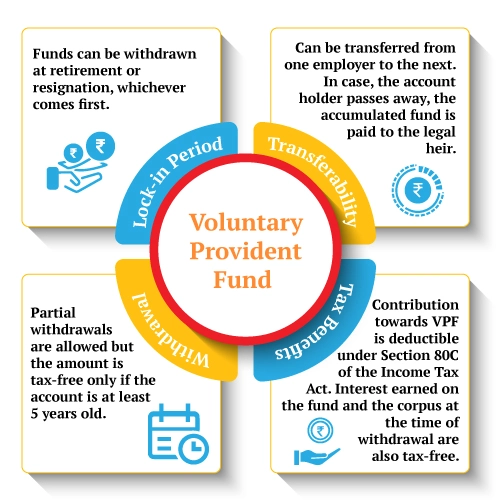
Voluntary Provident Fund permits an employee a maximum contribution of up to 100% of their basic salary and Dearness Allowance. The interest rates of both VPF and EPF are the same.

What are the Features of a Voluntary Provident Fund?

The Voluntary Provident Fund has some unique features. They are summed up as follows:

  1. The Voluntary Provident Fund is an extension of the Employee Provident Fund
  2. No employee is under any compulsion to contribute towards the Voluntary Provident Fund
  3. It can be functional till an employee’s retirement or resignation
  4. The maturity amount for the Voluntary Provident Fund is dependent on the invested amount, which, in turn, depends on the employee’s discretion
  5. The rate of interest under the Voluntary Provident Fund is finalised by the Government of India
  6. It has a lock-in period of 5 years, meaning that once you contribute towards the Voluntary Provident Fund, it cannot be discontinued before the term of 5 years is completed

What are the 5 Benefits of Voluntary Provident Fund?

Employees who receive monthly salaries in their salary account are eligible to invest in the Voluntary Provident Fund. Here are five benefits of the Voluntary Provident Fund:

  • Tax Benefits: Voluntary Provident Fund allows employees to enjoy exemption on their contribution, exemption on the principal amount, and exemption on the interest (EEE). This qualifies the Voluntary Provident Fund as one of the tax-saving plans.
  • Secure Investment: There are absolutely no risks involved as the Voluntary Provident Fund is managed by the Government of India. As compared to other long-term investment schemes offered by private companies, the Voluntary Provident Fund is risk-free and hence secure.
  • Ease of Application: Applying for a Voluntary Provident Fund account is quite simple. Employees have to reach out to their finance team or HR manager and request them to open a Voluntary Provident Fund account by submitting the required documents.
  • Higher Rate of Interest: The Voluntary Provident Fund provides the benefit of a considerably high rate of interest compared to other investment options offered by private firms. Currently, the rate of interest under VPF is 8.5% per annum.
  • Ease of Transfer: If an employee transfers or changes their job, their Voluntary Provident Fund can be transferred from the old company to the new one without any hassle.

What are the Documents Required for the Voluntary Provident Fund?

The Voluntary Provident Fund requires you to submit some documents for you to be eligible for it. These documents are as follows:

  1. Comprehensive company profile
  2. Company registration certificate under the Ministry of Finance (MoF)
  3. Two forms: Form 24 and Form 49
  4. Memorandum and Articles of Association (MOA & AOA) in case of an ‘Sdn Bhd’ company
  5. Business Registration Certificate i.e. Form 9 and Form D

It’s recommended that employees check with their employers to determine if any other important documents are required for opening the Voluntary Provident Fund account.


How Much is the Tax Exemption under the Voluntary Provident Fund?

The most unique feature of the Voluntary Provident Fund is the tax exemption it offers to employees. An employee can avail of tax benefits of up to ₹1.5 lakh.

Moreover, the interest earned from the contribution to the Voluntary Provident Fund is also exempt. However, this shall not be the case if the rate of interest exceeds 9.50% per annum.

How Much is the Rate of Interest under the Voluntary Provident Fund?

The rate of interest under the Voluntary Provident Fund is established by the Government of India and is revised every year. For the financial year 2022-2023, the Voluntary Provident Fund had a rate of interest of 8.10% per annum. Previous to that, the interest rate was 8.65%.

From the financial years 2013-2014 to 2022-2023, the Voluntary Provident Fund has steadily maintained a higher interest rate than EPF.


What are the Withdrawal Facilities Under the Voluntary Provident Fund?

The Voluntary Provident fund permits both complete withdrawals and partial ones (in the form of a loan). For withdrawals before the minimum term of 5 years, tax is levied on the accumulated maturity sum. The final maturity amount is paid after the resignation or retirement of the employee.

In case of the sudden death of the account holder, their chosen nominee receives the accumulated sum under VPF. The Voluntary Provident Fund allows for the withdrawal of money at any time. This makes the Voluntary Provident Fund a dependable option in case of financial emergencies.

What are the Rules and Regulations under VPF?

Some rules and regulations under the Voluntary Provident Fund that should be kept in mind are summed up below:

  1. Contribution to the Voluntary Provident Fund account is not mandatory.
  2. The rate of interest is set by the Government of India and is subject to change yearly. The interest rate can increase or decrease depending on the financial year.
  3. Full withdrawal of the maturity amount is permitted after resignation or retirement.
  4. The Voluntary Provident Fund is applicable only for employees who have an EPF account and work for companies under the Employees’ Provident Fund Organisation (EPFO). It isn’t applicable to people working in the unorganised sectors.
  5. Voluntary Provident Fund can be opened at any time during a given financial year. Once the investment starts, it cannot be discontinued.
  6. Voluntary Provident Fund allows partial withdrawals in the form of loans. However, the withdrawn amount is taxable if it is withdrawn before the maturity date.


How can ULIP Plans by Canara HSBC Life Insurance Help You?

It is always better to have options. If you do not benefit from an EPF or a VPF, you can opt for a customisable Unit Linked Individual Life Insurance Savings Plan. It provides unparalleled flexibility and control over your savings.

The Voluntary Provident Fund is a reliable Government-managed scheme, while a ULIP plan offered by Canara HSBC Life Insurance can offer you the following benefits:

  • Option to choose between three covers for different life stages
  • Assured Loyalty additions
  • Systematic withdrawals

Choosing a ULIP gives you more control over your savings and investments. Also, it protects you and your loved ones with life cover. Investing wisely will help you achieve all the milestones of your life. 

Conclusion

Saving for the future does not have to be complex or risky. So, if you choose the Voluntary Provident Fund for its guaranteed returns or explore other investment tools, the goal remains the same. VPF is a suitable choice for salaried individuals seeking tax benefits alongside steady growth. However, it may not be available to everyone, especially those outside formal employment. 

In such cases, smart alternatives like ULIPs can offer both insurance and market-linked growth, along with flexible control over your investment. At Canara HSBC Life Insurance, we bring this ease of accessibility regarding such plans to your smartphones. You can explore and even make a safe purchase of ULIP plans through our official website.

Explore all the available options to buy the best savings plan for a secure financial future today.


Recent Blogs

ESIC Scheme

What is ESIC? Employees' State Insurance Corporation Explained

08 July '26
3915 Views
15 minute read
Want to know about ESIC? Learn what Employees' State Insurance Corporation is, its benefits, eligibility & coverage for salaried employees in India.
Read More
Saving Plan
Sum Assured Meaning Thum Desktop

What is Sum Assured in Insurance? Meaning and Definition

19 Apr '26
4224 Views
8 minute read
A sum assured is a fixed amount paid to the nominee of the insurance policy in the unfortunate event of the policyholder's demise during the policy tenure. Learn more about what is sum assured, and it's meaning.
Read More
Saving Plan
What Are The Best Long Term Saving And Investment Plans Thum Desktop

Best Long-Term Saving and Investment Plans Explained

15 Apr '26
1284 Views
8 minute read
Learn about the best long-term saving and investment plans, how they help build wealth over time, and which options suit different financial goals and life stages.
Read More
Saving Plan
Senior Citizen Savings Scheme Thum Desktop

Senior Citizen Savings Scheme (SCSS): A Complete Guide

10 Apr '26
5625 Views
10 minute read
Learn what the Senior Citizen Savings Scheme (SCSS) is, how it works, interest rates, eligibility rules and why it is a popular low-risk option for retirees.
Read More
Saving Plan
Compound Interest Beat Inflation Thum Desktop

Top 5 Investment Options for NRIs in India

16 Mar '26
3495 Views
9 minute read
Explore the top investment options for NRIs in India, including tax efficiency, repatriation rules and how to choose plans aligned with long-term goals.
Read More
Saving Plan
Guaranteed Return Plan Thum Desktop

Top Investments with Guaranteed Returns in India in 2026

13 Mar '26
1981 Views
8 minute read
Discover top investment options in India with guaranteed returns. Secure your financial future with reliable plans from Canara HSBC Life Insurance. Explore now!
Read More
Saving Plan
When Should One Start Saving And What Is The Best Savings Plan Thum Desktop

When Should You Start Saving? Choose the Best Savings Plans

11 Mar '26
1091 Views
7 minute read
Learn the right age to start saving and how to choose the best savings plan to achieve your financial goals effectively.
Read More
Saving Plan
Compound Interest Beat Inflation Thum Desktop

Pradhan Mantri Jan Dhan Yojana: Eligibility & Benefits Explained

04 Mar '26
3855 Views
9 minute read
Pradhan Mantri Jan Dhan Yojana ensures financial inclusion by providing access to banking, insurance, pension, and credit for Indian citizens. Learn more!
Read More
Saving Plan
Best Saving Plans

12 Best Saving Plans & Schemes in India with High Returns

04 Mar '26
897 Views
7 minute read
Know about the best saving plans in India such as NSC, SCSS, RD, MIS, PPF, KVP, SSY, Atal Pension Yojana and more. Read this blog and choose the best savings scheme for yourself.
Read More
Saving Plan

Savings and Investment Plans from Canara HSBC Life Insurance

We bring you a collection of popular Canara HSBC life insurance plans. Forget the dusty brochures and endless offline visits! Dive into the features of our top-selling online insurance plans and buy the one that meets your goals and requirements. You and your wallet will be thankful in the future as we brighten up your financial future with these plans.


Fixed Returns, Zero Risks & Worries

iSelect Guaranteed Future Plus
  • 4 Plan Options
  • Life cover + Guaranteed benefits
  • Accidental death benefit
  • Premium protection cover

Save, Dream, Plan. Live Peacefully

iSelect Guaranteed Future Plan
  • 4 plan options
  • Guaranteed Maturity Benefit
  • Premium Protection Cover
  • Tax Benefits