public-provident-fund-ppf-features-and-tax-benefits

Public Provident Fund (PPF): Features & Tax Benefits

From ₹500 to ₹1.5L, PPF offers tax savings, stable returns, and financial protection. Discover why it’s a must-have in your retirement portfolio.

Written by : Knowledge Center Team

2026-01-20

1906 Views

10 minutes read

Public Provident Fund or PPF was introduced in 1968, as a means to provide everyone equal opportunity to save for their retirement. The 15-year savings scheme was to bring the self-employed and unorganised sector employees on par with the organised sector workers.

This investment option has evolved significantly over the years and today serves as one of the best sources of long-term savings and tax benefits. In this article, we will discuss what is PPF scheme and highlight its features and tax benefits.

Key Takeaways

  • PPF offers guaranteed returns at 7.1% p.a., compounded annually, with full tax exemption under Section 80C

  • The investment has a 15-year lock-in period with flexible extensions in 5-year blocks and partial withdrawals allowed after 5 years

  • PPF accounts are protected from legal attachment, offering a secure retirement fund even in financial distress

  • You can invest as little as ₹500 and up to ₹1.5 lakh annually, making PPF accessible and scalable for all income groups

  • Maturity proceeds and interest earned are completely tax-free, making PPF an ideal choice for long-term, tax-efficient savings

What is Public Provident Fund (PPF)?

Public Provident Fund (PPF) is a long-term savings product that provides guaranteed returns and tax benefits. One great advantage of this scheme is that it allows you to keep your investments secure while generating interest at competitive rates (7.1% per annum).

Funds in a PPF account are protected against all contingencies, including bankruptcy or loss of job during tenure. As such, it is one of the safest investment options for individuals with a low-risk appetite.
Features of a PPF Account

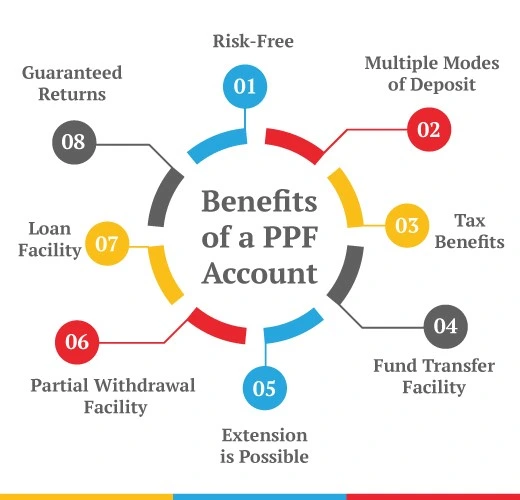
The PPF account has kept up with the changing market situations and is one of the most popular retirement-related investments. The following features of the PPF account make it one of the must-have investments in India:

  1. Only Indian residents can invest in PPF
  2. You can operate only one PPF account in your name
  3. The PPF scheme's duration is 15 years.
  4. The minimum deposit you can make per year is ₹ 500 (per deposit), and the maximum deposit can be ₹ 1.5 lakhs
  5. You can get tax benefits up to ₹ 1.5 lakh as stated under Section 80C of the Income Tax Act, 1961
  6. The maturity value and interest income from the PPF account are exempt from tax
  7. PPF offers safe returns with a sovereign guarantee. Thus, it is one of the safest investments in India
  8. Extend the account after maturity in batches of 5 years for any number of times
  9. Partial withdrawal allowed after 5 years - up to 50% of the fund balance from the end of the 4th year or the year preceding withdrawal
  10. Withdrawals are tax-free from the PPF account
  11. A PPF account cannot be attached by a court against your borrowings. Thus, PPF also offers financial safety to your family
  12. For FY 2025–26, the scheme offers an interest rate of 7.1% per annum, compounded annually for optimal growth

Build Guaranteed Savings for Your Future Goals

Please enter correct name Please enter the Full name
Please enter valid mobile number Please enter Mobile Number
Please enter valid email Please enter Email

Enter OTP

An OTP has been sent to your mobile number

Didn’t receive OTP?

Application Status

Name

Date of Birth

Plan Name

Status

Unclaimed Amount of the Policyholder as on

Name of the policy holder

Policy No.

Address of the Policyholder as per records

Unclaimed Amount

Error

Sorry ! No records Found

.  Please use this ID for all future communications regarding this concern.

Request Registered

Thank You for submitting the response, will get back with you.

Thank you for your interest in our product. Our financial expert will connect with you shortly to help you choose the best plan.

When to Invest in a PPF Account?

You can open a PPF account at any time you want in a year. It is best to invest in this fund as it will offer a better power of compounding over the years. The account can be extended for five years multiple times after maturity. Take care of the following while starting your PPF investments:

  • Since there is no upper age limit for opening a PPF account, you can also invest in PPF for a tax-free pension after retirement.
  • The maximum limit for annual contribution is limited. So, starting early helps you maximise returns.

Recommended Reading - Compound Interest Investment

How to Draw Tax-Free Pension from PPF?

Creating your tax-free pension after you turn 60 is easy with PPF if you start investing in the plan early, i.e. before or by 30 years of age.

Assuming you invest ₹ 8500 per month in PPF and earn an average return of 7% per annum, at the age of 60, you will have approximately ₹ 1 crore in your PPF account.

Using the partial withdrawal facility, you can withdraw an average income of ₹ 68,000 per month from the deposit up to the age of 90.

While the total annual income amounts to more than ₹ 8 lakhs, this entire amount is free from any direct or indirect tax liability.

How to Open a PPF Account?

You can open a PPF account at a post office or any centralised bank either offline through a branch or online banking.

Documents Required to Open a PPF Account

  • PPF account opening application form
  • KYC documents - Aadhaar, voter's id, driving license, etc.
  • Residential address proof
  • Nominee declaration form
  • Passport-size photograph

Process of Opening a PPF Account

  • Offline Method
  1. Visit your nearest Post Office or Bank
  2. Complete the application form and submit all required documents
  3. Once your account is opened, you can deposit in a lump sum or invest over time
  • Online Method
  1. Log in to the net banking portal of your bank
  2. Find and click the option 'Open a PPF Account
  3. Select the type of account you want to open - Self Account/Minor Account
  4. Enter all the relevant information in the application form and verify the details
  5. Enter the total amount you wish to deposit per financial year
  6. You can also set standing instructions that allow an automatic deposit to your PPF account as per your preferred intervals
  7. Submit the application. An OTP will be sent to your registered mobile number to confirm the transaction. Enter the OTP.
  8. After you have completed all the above steps, your PPF account will be created    

How to Withdraw Money from PPF Account?

An individual can withdraw money from PPF after it has been in the account for a minimum of 5 years. There is no specific duration for this.

The withdrawal amount cannot exceed 50% of the total amount in your account or a maximum limit decided by the government every year.

Withdrawal Process

1. Download Form C from your bank's/post office website. Fill in the relevant details
2. Submit the form to the bank/post office branch where you have your PPF account

What is Form C in PPF?

Form C consists of the following three sections:

Section 1: The declaration section wherein you need to provide details such as your PPF account number and the amount you wish to withdraw. Along with that, you also have to specify how many years have passed since you opened the PPF account.

Section 2: The Office Use Section which comprises details such as:

  • Date of the initial subscription
  • The total amount available in your PPF account
  • The date on which the previous withdrawal was allowed
  • The total amount available for withdrawal as per para 9(1)/9(3) of the scheme
  • The amount of money sanctioned for withdrawal

Section 3: The bank details section, asks for your bank details such as your bank account number, IFSC code, etc.

Alternative Investment Options to PPF

Two investments that are comparable to PPF and even better for aggressive investors are as follows:

National Pension Scheme (NPS)

NPS is a government-sponsored pension scheme for retirement savings in India. It is regulated and governed by PFRDA (Pension Fund Regulatory and Development Authority).

An NPS Account offers the following benefits:

  • Invest in a portfolio of investments as per your risk appetite
  • Safeguards retirement as normal withdrawals not available before 60
  • The employer can also contribute to your NPS account
  • Additional deduction of up to ₹ 50,000
  • NPS is one of the most economical/low-cost investment options
  • Regardless of job changes, state of residence, or physical mobility, your NPS account or PRAN remains the same

Also Visit - How to Invest in NPS?

Unit Linked Insurance Plans (ULIPs)

A ULIP is a life insurance plan whic allows investment into diversified market portfolios of equity and debt. When you buy a ULIP, part of the premiums goes towards your life insurance, and the rest is invested in the fund of your choice.

  • You can choose to invest in stocks, bonds, or some mixture of both based on your risk tolerance and long-term goals.
  • You can stay invested in ULIPs like Promise4Growth Plus from Canara HSBC Life Insurance for up to 99 years of age
  • Since partial withdrawals are tax-free from ULIPs, you can also use ULIPs to create a tax-free pension stream

Conclusion

PPF is a low-risk investment option that provides people with a decent tax-free return. It is also an effective retirement savings tool for those who do not want to invest in equities. The returns are comparatively low but steady and predictable, which makes it a great long-term investment plan for both new and experienced investors. 

So, if you're aiming to build a tax-free pension or secure your future with minimal market exposure, opening a PPF account is a practical first step toward financial independence.

Savings and Investment Plans from Canara HSBC Life Insurance

We bring you a collection of popular Canara HSBC life insurance plans. Forget the dusty brochures and endless offline visits! Dive into the features of our top-selling online insurance plans and buy the one that meets your goals and requirements. You and your wallet will be thankful in the future as we brighten up your financial future with these plans.


Fixed Returns, Zero Risks & Worries

iSelect Guaranteed Future Plus
  • 4 Plan Options
  • Life cover + Guaranteed benefits
  • Accidental death benefit
  • Premium protection cover

Save, Dream, Plan. Live Peacefully

iSelect Guaranteed Future Plan
  • 4 plan options
  • Guaranteed Maturity Benefit
  • Premium Protection Cover
  • Tax Benefits

Recent Blogs

ESIC Scheme

What is ESIC? Employees' State Insurance Corporation Explained

08 July '26
3915 Views
15 minute read
Want to know about ESIC? Learn what Employees' State Insurance Corporation is, its benefits, eligibility & coverage for salaried employees in India.
Read More
Saving Plan
Sum Assured Meaning Thum Desktop

What is Sum Assured in Insurance? Meaning and Definition

19 Apr '26
4224 Views
8 minute read
A sum assured is a fixed amount paid to the nominee of the insurance policy in the unfortunate event of the policyholder's demise during the policy tenure. Learn more about what is sum assured, and it's meaning.
Read More
Saving Plan
What Are The Best Long Term Saving And Investment Plans Thum Desktop

Best Long-Term Saving and Investment Plans Explained

15 Apr '26
1284 Views
8 minute read
Learn about the best long-term saving and investment plans, how they help build wealth over time, and which options suit different financial goals and life stages.
Read More
Saving Plan
Senior Citizen Savings Scheme Thum Desktop

Senior Citizen Savings Scheme (SCSS): A Complete Guide

10 Apr '26
5625 Views
10 minute read
Learn what the Senior Citizen Savings Scheme (SCSS) is, how it works, interest rates, eligibility rules and why it is a popular low-risk option for retirees.
Read More
Saving Plan
Compound Interest Beat Inflation Thum Desktop

Top 5 Investment Options for NRIs in India

16 Mar '26
3495 Views
9 minute read
Explore the top investment options for NRIs in India, including tax efficiency, repatriation rules and how to choose plans aligned with long-term goals.
Read More
Saving Plan
Guaranteed Return Plan Thum Desktop

Top Investments with Guaranteed Returns in India in 2026

13 Mar '26
1981 Views
8 minute read
Discover top investment options in India with guaranteed returns. Secure your financial future with reliable plans from Canara HSBC Life Insurance. Explore now!
Read More
Saving Plan
When Should One Start Saving And What Is The Best Savings Plan Thum Desktop

When Should You Start Saving? Choose the Best Savings Plans

11 Mar '26
1091 Views
7 minute read
Learn the right age to start saving and how to choose the best savings plan to achieve your financial goals effectively.
Read More
Saving Plan
Compound Interest Beat Inflation Thum Desktop

Pradhan Mantri Jan Dhan Yojana: Eligibility & Benefits Explained

04 Mar '26
3855 Views
9 minute read
Pradhan Mantri Jan Dhan Yojana ensures financial inclusion by providing access to banking, insurance, pension, and credit for Indian citizens. Learn more!
Read More
Saving Plan
Best Saving Plans

12 Best Saving Plans & Schemes in India with High Returns

04 Mar '26
897 Views
7 minute read
Know about the best saving plans in India such as NSC, SCSS, RD, MIS, PPF, KVP, SSY, Atal Pension Yojana and more. Read this blog and choose the best savings scheme for yourself.
Read More
Saving Plan