how-you-should-invest-in-your-20s

How Should You Invest in Your 20s?

Let’s learn how investing in your 20s builds wealth, uses compounding, and sets you up for lifelong financial security.

Written by : Knowledge Centre Team

2026-01-08

1088 Views

7 minutes read

Investing in your 20s is a great start for long-term financial stability. This phase of life is related to professional growth, fewer financial responsibilities, and greater flexibility to take calculated risks. One of the most common questions young earners ask is, “How should I invest in my 20s?” The answer lies in understanding your goals, choosing suitable instruments, and building disciplined financial habits.

In the beginning, your investment journey enables you to recover from initial errors, adjust your strategies over time, and gradually create a diversified portfolio. As your career progresses, the lessons learned in your 20s will shape how confidently and effectively you manage money in later years. Before starting, first understand the benefits of investing in your 20s.

Key Takeaways 

  • Create and follow a monthly budget to track expenses and increase savings potential.

  • Diversify your investments across equity, debt, and government schemes for balanced growth.

  • Take advantage of tax-saving instruments like ELSS, ULIPs, PPF, and NPS.

  • Review and adjust your portfolio regularly to match changing life goals and market conditions.

  • Invest in your skills and education to increase income potential and financial flexibility.

Benefits of Investing In Your 20s

If you are in your 20s, investing is crucial. Here are some benefits that you take into consideration.

  • The Power of Compounding: The power of compounding means reinvesting the interest you get from the invested amount instead of spending it elsewhere. 

    For example
    , if you invest ₹100 with 7% interest per annum, the interest would get added to ₹100, and the total amount would become the new principal.

Build a Financial Plan that Protects and Grows Your Wealth

Please enter correct name Please enter the Full name
Please enter valid mobile number Please enter Mobile Number
Please enter valid email Please enter Email

Enter OTP

An OTP has been sent to your mobile number

Didn’t receive OTP?

Application Status

Name

Date of Birth

Plan Name

Status

Unclaimed Amount of the Policyholder as on

Name of the policy holder

Policy No.

Address of the Policyholder as per records

Unclaimed Amount

Error

Sorry ! No records Found

.  Please use this ID for all future communications regarding this concern.

Request Registered

Thank You for submitting the response, will get back with you.

Thank you for your interest in our product. Our financial expert will connect with you shortly to help you choose the best plan.

  • Beating Inflation: Inflation fluctuates over time and gradually reduces the purchasing power of money. To preserve and grow your wealth, it is essential to invest in a diversified portfolio across various asset classes. This approach helps you earn inflation-adjusted returns while also building long-term financial security and capital appreciation.
  • Additional Income: Starting your investment journey early allows you to benefit from multiple income streams over time. You may earn returns in the form of interest, dividends, capital gains, and more. These earnings can supplement your primary income, offering greater financial flexibility and helping you meet both short- and long-term goals.

    Also Read - Dividend Distribution Tax (DDT)
  • Good Debt: You can avail of a home loan to invest in real estate that is likely to appreciate in value over time. Purchasing property through bank finance requires margin money, which you should plan and save for. Additionally, home loans offer tax benefits under Sections 80C and 24(b) of the Income Tax Act.

    Note: Tax benefits are subject to change in tax laws. Please consult your tax advisor.
  • Systematic Investment Plan (SIP): Investing in a lump sum is not possible for everyone. If you start early, you can invest smaller amounts over a longer term. Besides the advantage of investing in smaller amounts, you benefit by spreading the risk. You will gain from the highs and still stay afloat during the lows in the market.

    Is investing in a SIP a good idea?

Investment Goals in the 20s

You have several dreams and aspirations when you are in your 20s. However, there are a few commonalities for all youngsters and generally top the charts:

  • Car: A car remains a symbol of financial independence and upward mobility. Beyond the status it offers, a four-wheeler provides enhanced safety, particularly important in large Indian cities. For most people starting their careers in their 20s, owning a car is one of the first major lifestyle goals.
  • Home: If you are planning to avail of a home loan, then doing it early has an advantage. You will get a longer tenure for repayment. The principal and interest components of the loan have tax benefits. You will also benefit from the appreciation in price of this property.
  • Wedding: Once you are employed and have worked for a few years, it is natural to think of marriage. Indian weddings are an expensive affair because you want all your friends, relatives and well-wishers to be part of this joy.
  • Vacation: Regular breaks from work are vital for mental and emotional well-being. Whether it’s an annual trip or a dream vacation, early financial planning helps you enjoy quality travel without disrupting your budget or relying on credit.Retirement

    Retirement is one of the most important financial milestones in your life. Given today’s high-speed and stressful work environment, you would want to end it early and go on your journey to explore the world. Starting your retirement savings early helps you with this goal as you can invest for the longer term, take more risk, and expect a higher rate of return.
  • Wealth: Conventional financial instruments such as term deposits are rarely helpful in generating wealth. Equities outperform all asset classes in the long run. Allocate a large portion of your money to equities when you are young. You will reap the rewards because the returns beat inflation, and you will get returns better than other investments.

    Click Here To Learn -
    Best Ways to Invest Money

Where to Invest in Your 20s?

Once your financial goals are clear, you must explore avenues to invest your hard-earned money. This investment should be diversified, comprehensive, and take care of your and your family’s needs in the short, medium and long-term.

Key options are listed below:
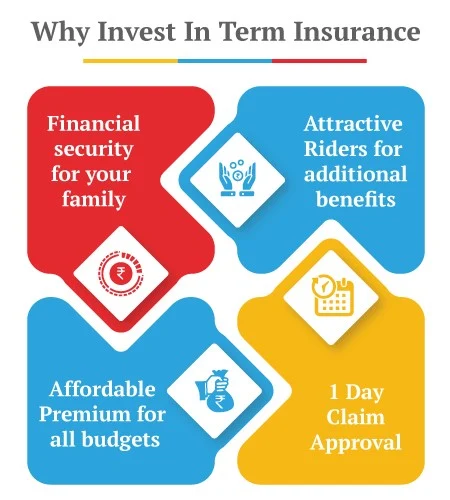
  • Term Insurance: Term insurance is a pure protection plan designed to provide financial security to your family in the event of your untimely death. It offers no maturity benefit unless you opt for a Return of Premium (ROP). The plan pays out the sum assured to your nominee only if you pass away during the policy term.
  1. Reasons to Buy a Term Insurance Plan: Here are a few  reasons to buy a Term Insurance:
    • Pure Protection: It provides life cover without any investment or savings component, ensuring your family is supported in your absence.
    • Affordable Premiums: Term plans offer high sum assured amounts at a low cost, especially when purchased at a younger age.
    • Premiums paid are eligible for deduction under Section 80C, helping reduce your taxable income.
    • Rider Options: You can enhance your policy with add-ons such as critical illness or accidental death riders for extra protection.
    • Peace of Mind: It offers financial security and stability to your dependents in the unfortunate event of your demise.
  • Equity Linked Savings Scheme (ELSS): ELSS is a tax-saving mutual fund scheme that primarily invests in equities and comes with a mandatory lock-in period of three years. It qualifies for tax deductions under Section 80C of the Income Tax Act.

    You can select an ELSS fund based on your risk tolerance and investment objectives, while also aiming for potentially higher long-term returns compared to traditional tax-saving instruments.
  • Unit Linked Insurance Plans (ULIPs): ULIPs are market-linked insurance products that combine life cover with investment opportunities. A portion of your premium goes towards life insurance, while the remainder is invested in equity, debt or balanced funds of your choice.

    Since ULIPs are linked to the market, returns are not guaranteed and are subject to market risks. You can choose and switch between available funds based on your financial goals and risk appetite. The maturity proceeds are exempt from tax under Section 10(10D) of the Income Tax Act, subject to conditions.

    You may consider ULIPs such as Promise4Growth Plus by Canara HSBC Life Insurance, which offers long-term financial planning with flexibility and added benefits:
    1. Invest in a mix of equity and debt funds based on your preference
    2. Switch funds anytime based on market movements and strategy
    3. Access automated portfolio strategies that manage asset allocation dynamically
    4. Receive loyalty and wealth boosters on long-term investments
    5. Benefit from partial withdrawals after five policy years for liquidity

Note: As these are market-linked instruments, past performance is not indicative of future returns. Fund values may fluctuate depending on market conditions.

  • Public Provident Fund (PPF): PPF is a Central Government guaranteed investment cum tax saving instrument, offering a 7.1% rate of interest. The amount deposited in PPF accounts is deductible, under Section 80C, from taxable income, whereas all withdrawals are exempt from taxes. Partial withdrawals are permitted only from the 7th year onwards.
  • National Pension Scheme (NPS): NPS is a pension scheme that is exempt from taxes at both the maturity and annuity (up to 40%) stages. You must try to invest at least 10% of your income into NPS to build a corpus for your retirement. On retirement, you can withdraw up to 60% of this corpus tax-free and opt to get a pension from the remaining 40%.

    Contributions to NPS are also deductible under Section 80C and Section 80CCD(1B) from your taxable income.

Mistakes to Avoid While Investing in Your 20s

Mistakes are common while investing in your 20s. You can learn from the mistakes that others have made, and there is plenty of information on common mistakes that people make. Some of them are listed below:

  • Living Without Budget: You may end up overspending and not saving a penny. It may also happen the other way round. You may invest almost all your income, not leaving any funds to manage your living expenses.
  • Being Credit-Wise: Relying on debt for lifestyle expenses can quickly lead to financial trouble. You should work on building prudent financial habits in your 20s. Try building your credit score by using small debts like credit cards within your repayment capacity. Your lines to avail credit should remain open for emergencies. A good credit score helps a lot in this direction.
  • Crossing Limits of Frugality: Being frugal is good. But depriving yourself of even basic needs is not a great idea. Maintain financial discipline; however, do spend money on healthcare as health is the ultimate wealth. Simultaneously, have health insurance policies to avoid draining your pockets in hospital emergencies.

Final Thoughts

Enjoy this important phase of your career to the fullest. However, do not lose sight of financial discipline. Invest wisely and focus on building a secure financial future. While there may be no perfect age to start investing, beginning early enables you to benefit from market fluctuations and long-term growth.

With insurance policies by Canara HSBC Life Insurance, you can easily secure your family’s future while helping you build wealth. When chosen wisely, your savings plan becomes more than an investment; it becomes your long-term commitment to safeguarding dreams and ensuring peace of mind.


Recent Blogs

Wealth Management Thum Desktop

Wealth Management: A Guide to Build and Protect Your Assets

08 July '26
2683 Views
10 minute read
Learn about wealth management, its importance, and how it helps you grow, preserve, and transfer your wealth effectively. Discover key strategies and benefits.
Read More
Financial Planning
Types Of Financial Planning Thum Desktop

Net Present Value (NPV): Full Form, Meaning & Formula

08 July '26
3909 Views
10 minute read
Net Present Value (NPV) measures an investment's total value and profitability. Learn how NPV helps in investment planning with Canara HSBC Life Insurance.
Read More
Financial Planning
Types Of Financial Planning Thum Desktop

Personal Finance: Definition, Meaning, Importance & Tips

08 July '26
1330 Views
10 minute read
Learn the basics of personal finance, including saving, investing, insurance and budgeting, to manage money better and build long-term financial security.
Read More
Financial Planning
Types Of Financial Planning Thum Desktop

What is Recurring Deposit (RD)? Meaning & Features

07 July '26
1907 Views
7 minute read
Recurring deposits are a popular investment choice that helps in building your savings. You can choose to put the money in a lump sum or monthly to meet your financial goals over a period of time.
Read More
Financial Planning
5 Family Financial Hacks To Use in 2025

Family Financial Planning: Smart Money Management Tips

17 June '26
3935 Views
10 minute read
Discover practical family financial planning tips, budgeting strategies, emergency fund planning, insurance, savings and debt management to build long-term financial security.
Read More
Financial Planning
Compound Annual Growth Rate Thum Desktop

Compound Annual Growth Rate: How to Calculate CAGR?

03 Apr '26
2899 Views
8 minute read
Understand CAGR with our detailed guide. Use our CAGR Calculator for accurate financial planning. Explore more at Canara HSBC Life Insurance.
Read More
Financial Planning
5 Habits To Quit This New Year For Better Finances

5 Habits To Quit This New Year For Better Finances

28 Feb '26
1987 Views
8 minute read
Give up 5 money-draining habits and step into the new year with smarter financial choices.
Read More
Financial Planning
What is SIP?

What is SIP - SIP Meaning, Types, How Does SIP Work?

24 Feb '26
1100 Views
7 minute read
SIP - Systematic Investment Plan is the best way to invest in mutual funds. Learn more about SIP Investment, its meaning, benefits, and how to find the best SIP plans.
Read More
Financial Planning
Tips on Save Money in 2026

How to Save Money? Tips on Save Money in 2026

18 Feb '26
1471 Views
10 minute read
How to save money - Learn the best tips and some simple ways to save money. Learn more about the benefits of saving money as soon as you start earning.
Read More
Financial Planning

Financial Planning - Top Selling Plans

We bring you a collection of popular Canara HSBC life insurance plans. Forget the dusty brochures and endless offline visits! Dive into the features of our top-selling online insurance plans and buy the one that meets your goals and requirements. You and your wallet will be thankful in the future as we brighten up your financial future with these plans.


Fixed Returns, Zero Risks & Worries

iSelect Guaranteed Future Plus
  • 4 Plan options
  • Life cover + Guaranteed benefits
  • Accidental death benefit
  • Premium protection cover

Save, Dream, Plan. Live Peacefully

iSelect Guaranteed Future
  • 5 Plan options
  • Option to choose PPT
  • Get Tax benefits
  • Premium protection cover