Written by : Knowledge Centre Team
Last published : 2026-01-10
13 minutes read
Share

Fixed Deposits (FDs) and Recurring Deposits (RDs) are seen as similar investment options because both offer stable returns with minimal risk. They are popular among investors who prefer safety and predictability over high-risk investments. While both guarantee fixed returns over a set period, the investment method is slightly different. Understanding these differences can help you select the most suitable option based on your financial objectives.
Key Takeaways
|
A Fixed Deposit (FD) is a savings option provided by banks and non-banking financial companies, where you deposit a lump sum amount for a fixed period and earn interest at a guaranteed rate.
An OTP has been sent to your mobile number

Sorry ! No records Found
Thank You for submitting the response, will get back with you.
Thank you for your interest in our product. Our financial expert will connect with you shortly to help you choose the best plan.
Some of the salient features are listed below:
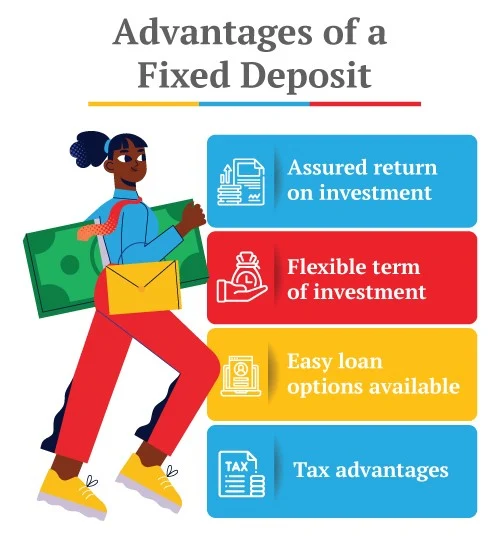
You may invest money for tenures ranging from 7 days to 10 years at predefined interest rates.
Once you open an FD, the interest rate is fixed and unaffected by market fluctuations.
The assured interest is guaranteed, and you receive the principal plus accrued interest at the end of the term of the tenure.
If you choose periodic interest payouts, you will receive the interest at regular intervals based on your selected frequency.
Premature FD withdrawals are allowed but usually attract a penalty or lower interest rate.
Tax-saving in fixed deposits with a 5-year lock-in period is eligible for deductions under Section 80C of the Income Tax Act.
You can avail of loans and overdrafts against FDs. The terms and interest rates vary across banks.
Most banks insist on opening a savings bank account if you want to place an FD with them. Crediting interest, transferring proceeds on maturity, etc., become easier if you have a savings bank account with the same bank.
Example: You invest ₹ 10,000 in a fixed deposit at an interest rate of 6% per annum for 5 years. At the end of 5 years, your investment would have grown to ₹13,469.
FDs are of different types and are offered by different entities. A few of the popular ones are listed below:
RD is a type of term deposit that allows you to systematically invest money over a period and earn guaranteed returns.
Some of the salient features of a recurring deposit are listed below:
Allows you to make regular deposits and earn returns that are higher than those offered for savings accounts.
Flexible, as you can invest periodically instead of in one lump sum.
RD tenure ranges from 6 months to 10 years.
The fixed interest rate depends on the tenure chosen. Interest rate is unaffected by subsequent changes due to market forces.
You may invest as low as ₹1000 each month.
Premature withdrawals are subject to a penalty, just like in FDs.
Helps inculcate a sustainable habit of saving.
You may give standing instructions to auto-debit the recurring amount. Saves you time, energy, and effort of transferring/depositing the amount at a defined frequency.
For Example, if you invest ₹833 per month in a recurring deposit at an interest rate of 6% per annum for 5 years. At the end of 5 years, your investment would have grown to ₹ 58,361.
RDs can be opened in banks, post offices, and NBFCs. The different types of RDs are listed below:
In an FD, you deposit only once and watch the principal grow over a predefined tenure, whereas in an RD, you must deposit money periodically over the defined tenure. Let’s discuss the differences below.
| Features | Fixed Deposit (FD) | Recurring Deposit (RD) |
|---|---|---|
Tenure | 7 days to 10 years | 6 months to 10 years. |
Investment type | One time | Recurring |
Investment Limit | Minimum ₹ 1000 (in public sector banks Minimum ₹ 5000 in other banks | Minimum ₹ 50 (in Canara Bank/public sector banks) Minimum ₹ 1000 in other banks |
Rate of Return | Even at the same rate of interest, FD would earn more interest as compared to RD | Even at the same rate of interest, RD would earn less interest as compared to FD |
Tax Benefits | 5-Year locked-in FDs are eligible for tax deduction u/s 80C | No benefits on investment |
TDS on Interest | 10% TDS on cumulative interest > ₹ 40,000 | 10% TDS on cumulative interest > ₹ 40,000 |
Loans | Loan and OD Facility | Generally not offered |
Withdrawal | Premature withdrawal is allowed (for non-tax saving FDs) with a penalty. | Premature withdrawal is allowed with a penalty. |
There are other credible, equally safe investment avenues that you can explore as an alternative to FDs and RDs. Some of them are listed below:
If you do not have a lump sum to invest in an FD, you may explore RDs. Both RD and FD are ideal options to earn guaranteed interest over predefined periods. Use an online FD/RD calculator by Canara HSBC Life Insurance to evaluate what suits you best. There are equally good avenues, such as ULIPs and endowment funds, that give stable returns and give additional benefits as well. Compare those too and put your money wisely by diversifying your investments.
Fixed Deposits and Recurring Deposits are safe ways to earn guaranteed returns. FDs suit lump sum investments, while RDs support regular savings. However, for better long-term growth, tax benefits, and life cover, explore options like Endowment Plans, PPFs, or ULIPs. Choose based on your financial goals and risk comfort. A balanced mix of investments ensures both security and higher returns over time.







We bring you a collection of popular Canara HSBC life insurance plans. Forget the dusty brochures and endless offline visits! Dive into the features of our top-selling online insurance plans and buy the one that meets your goals and requirements. You and your wallet will be thankful in the future as we brighten up your financial future with these plans.