Written by : Knowledge Centre Team
Last published : 2025-12-25
6 minutes read
Share

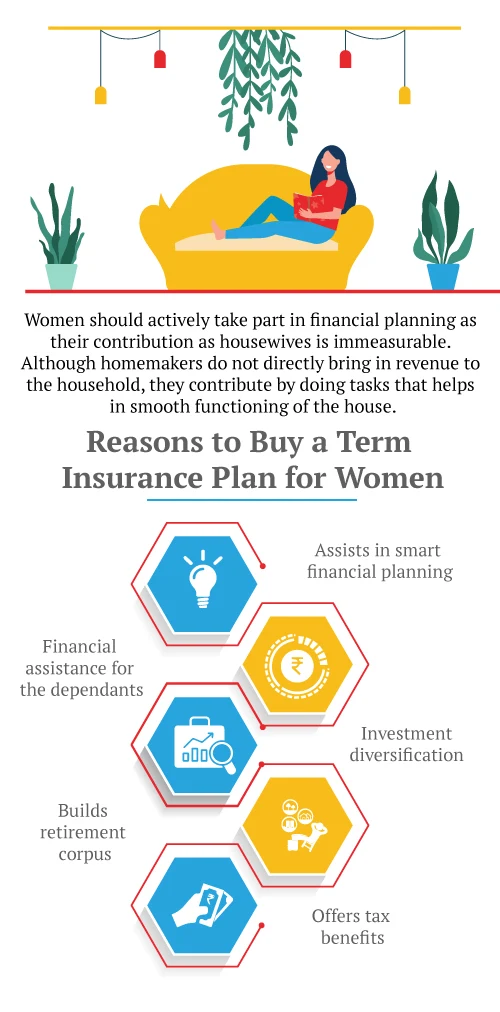
The simple homemaker may not earn a salary, but she holds the household together, from managing daily tasks and caregiving to ensuring everything runs smoothly. If she’s no longer around, replacing her role would come at a significant cost.
While her work is unpaid, it carries real economic value. Think about it: you’d need to hire a cook, a nanny, a cleaner, and even a manager to fill in. That’s why many experts now argue that a homemaker’s contribution should be counted in the country’s GDP. A term insurance plan in this context can be a financial backup for the family to at least ward off any possible financial challenges caused by the homemaker’s absence.
The above points clearly advocate the necessity of providing term plans for housewives. However, can a housewife buy a term insurance plan?
Key Takeaways
|
Traditionally, life insurance was seen as a way to provide financial protection to the dependents in case of the demise of the sole breadwinner of the family. In return for this financial protection, called “Sum Assured”, the insurance company would receive “Premiums” for the defined policy term.
The amount under “Sum Assured” depended on the age and annual income of the insured and was calculated at approximately 10-15 times the annual income. The underlying logic of this thumb rule was simple: If the income-earner dies, his income*15 times should be sufficient for the children to become financially independent or for the wife to find alternative sources of income.
Also, in the interim, the corpus of sum assured will earn interest, thus adding to the kitty and giving more time to sustain life.
In the case of homemakers, there was no clear human life value because they did not “earn” a specific income. Their death did not cause any loss of income. This logic kept housewives outside the purview of term life insurance.
Although you could still buy life insurance policies in the name of your homemaker spouse.
An OTP has been sent to your mobile number

Sorry ! No records Found
Thank You for submitting the response, will get back with you.
Thank you for your interest in our product. Our financial expert will connect with you shortly to help you choose the best plan.
Term policies, like the iSelect Smart360 Term Plan by Canara HSBC Life Insurance, allow you to include your spouse in the same plan.
Here are the salient features of the iSelect Smart360 Term Plan, and how joint life cover helps:
The disability benefits help cover incidental expenses incurred that may not be covered by the regular Mediclaim policies, whereas the Accidental Death rider gives an add-on Sum Assured to provide more financial cushion to the family. Child Care Benefits help the child pursue their aspirations even after the untimely demise of the parents.
Modern schools of thought have redefined the way new-age insurers look at the contributions of homemakers. As mentioned at the beginning of this article, would you not pay a cook, a nanny or house help to manage the household in the absence of the “housewife”? This is exactly the annual expense that you would incur in case of the untimely and unfortunate demise of the backbone of the family.
Here’s an approximate monthly cost if household services were replaced by paid professionals:
Expense Type | Amount |
|---|---|
Cook* | ₹ 15,000 |
Nanny* | ₹ 14,000 |
Driver** | ₹ 20,000 |
House help*** | ₹ 15,000 |
*Average salary in Delhi based on figures available on Indeed.com
**Average salary in Delhi based on figures available on PayScale/Glassdoor
** Driving the kids to school/coaching, if applicable, etc
***For chores including sweeping/mopping/washing utensils
The table gives an estimate of your spouse’s economic contribution to the household, although the actual contribution is priceless because no cook or nanny can ever replace the emotional strength that a homemaker provides to the family. However, this quantification is necessary for calculating the Human Life Value (HLV), which forms the basis of extending term insurance covers to homemakers.
The total monthly expense will range from ₹30,000 to ₹60,000, depending on the services, and this works out to an annual expense of ₹3.6 lakhs to ₹7.2 lakhs. If your spouse is about 35 years of age, you must extrapolate the annual expense, using the same thumb rule that was used for income earners, factoring in the inflation as well. Some components of the expenses, such as Nanny, Driver, may not exist in future, though.
Even with a modest ₹3.6 lakh expense per year, the thumb rule of 10 times, when applied, the projected corpus works out to ₹36 lakh. This is the minimum insurance cover that the housewife should have based on the financial calculations. The exact amount will vary based on age and other personal circumstances of the family.
Here’s all you need to know about term insurance for housewives.
The term “housewife” has now evolved to be called “homemaker” to make it more gender-inclusive, as more people of other genders also opt to stay at home to manage the household chores and run errands for the family when needed. Of course, this trend is very recent, and the sheer magnitude of stay-at-home women is still staggeringly high. Adding them under the umbrella of term insurance will surely add to the family’s financial stability.
Canara HSBC Life Insurance offers online term insurance plans to secure your family financially in your absence.